I work all day, and get half-drunk at night.
Waking at four to soundless dark, I stare.
In time the curtain-edges will grow light.
Till then I see what's really always there:
Unresting death, a whole day nearer now,
Making all thought impossible but how
And where and when I shall myself die.
Arid interrogation: yet the dread
Of dying, and being dead,
Flashes afresh to hold and horrify.
The mind blanks at the glare. Not in remorse
- The good not done, the love not given, time
Torn off unused - nor wretchedly because
An only life can take so long to climb
Clear of its wrong beginnings, and may never;
But at the total emptiness for ever,
The sure extinction that we travel to
And shall be lost in always. Not to be here,
Not to be anywhere,
And soon; nothing more terrible, nothing more true.
This is a special way of being afraid
No trick dispels. Religion used to try,
That vast, moth-eaten musical brocade
Created to pretend we never die,
And specious stuff that says No rational being
Can fear a thing it will not feel, not seeing
That this is what we fear - no sight, no sound,
No touch or taste or smell, nothing to think with,
Nothing to love or link with,
The anasthetic from which none come round.
And so it stays just on the edge of vision,
A small, unfocused blur, a standing chill
That slows each impulse down to indecision.
Most things may never happen: this one will,
And realisation of it rages out
In furnace-fear when we are caught without
People or drink. Courage is no good:
It means not scaring others. Being brave
Lets no one off the grave.
Death is no different whined at than withstood.
Slowly light strengthens, and the room takes shape.
It stands plain as a wardrobe, what we know,
Have always known, know that we can't escape,
Yet can't accept. One side will have to go.
Meanwhile telephones crouch, getting ready to ring
In locked-up offices, and all the uncaring
Intricate rented world begins to rouse.
The sky is white as clay, with no sun.
Work has to be done.
Postmen like doctors go from house to house.
~Philip Larkin
10 June 2011
Aubade

25 May 2011
Courage and Wisdom
There is a Buddhist saying that goes: "Courage opens the door to Wisdom."
On the surface, courage and wisdom seems to be rather different virtues that have no relations with each other. But courage is the will to take action. And this is important for the development of wisdom. Why is that so?
Humans in their natural state are generally rational beings. But in the face of adversities, it is not common for us to make silly decisions. For example, we will be hard-pressed to find criminals who are not aware that their crimes are wrong. However, crimes are committed because these criminals are in a dire situation which they cannot handle. And when they do not have the courage to stop themselves, they ended up making irrational decisions.
Courage provided the calm needed to analysis our situations. And the practice of this calmness causes the development of wisdom.
So how do we develop courage?
From wisdom.
What?!
Wisdom is the capacity to discern right from wrong. When wisdom develops, we gain the confidence that our decisions are the right ones. And the more confidence we derive, the greater our courage in executing the decisions.
Wouldn't we obtain a cyclic logic then? How do we even begin to enter this cycle of courage and wisdom?
We know about satellites. We send them into orbit. How? We first generate a huge amount of energy to send the rocket carrying the satellite into the sky. This energy will help pierce through our atmosphere and bring the satellite into orbit. Once in orbit, it is a matter of tapping into the power of gravity.
In the same way, we first make a determined vow. This vow is the vow to have compassion for others. It is through this vow that our desire to improve our community, and the lives of the people around us meaningful.
Only this vow can help us to overcome our fundamental darkness and send us into the "orbit" of courage and wisdom. And tapping into the power of Nam-myoho-renge-kyo is as though tapping into the power of gravity to keep us in the rhythm of constantly developing courage and wisdom.

On the surface, courage and wisdom seems to be rather different virtues that have no relations with each other. But courage is the will to take action. And this is important for the development of wisdom. Why is that so?
Humans in their natural state are generally rational beings. But in the face of adversities, it is not common for us to make silly decisions. For example, we will be hard-pressed to find criminals who are not aware that their crimes are wrong. However, crimes are committed because these criminals are in a dire situation which they cannot handle. And when they do not have the courage to stop themselves, they ended up making irrational decisions.
Courage provided the calm needed to analysis our situations. And the practice of this calmness causes the development of wisdom.
So how do we develop courage?
From wisdom.
What?!
Wisdom is the capacity to discern right from wrong. When wisdom develops, we gain the confidence that our decisions are the right ones. And the more confidence we derive, the greater our courage in executing the decisions.
Wouldn't we obtain a cyclic logic then? How do we even begin to enter this cycle of courage and wisdom?
We know about satellites. We send them into orbit. How? We first generate a huge amount of energy to send the rocket carrying the satellite into the sky. This energy will help pierce through our atmosphere and bring the satellite into orbit. Once in orbit, it is a matter of tapping into the power of gravity.
In the same way, we first make a determined vow. This vow is the vow to have compassion for others. It is through this vow that our desire to improve our community, and the lives of the people around us meaningful.
Only this vow can help us to overcome our fundamental darkness and send us into the "orbit" of courage and wisdom. And tapping into the power of Nam-myoho-renge-kyo is as though tapping into the power of gravity to keep us in the rhythm of constantly developing courage and wisdom.
"To be fearless no matter what happens--that is the root of true happiness. To move forward resolutely regardless of what lies in store--that is the spirit, the resolve, that leads to human victory." ~ Daisaku Ikeda
05 May 2011
Voting and Maslow's hierarchy of needs
Like many fellow citizens, I have been actively perusing news on the election here in Singapore over the past two weeks. In between, I took a short trip to Hong Kong with the fiancée over the Labour Day weekend. Incidentally, we encountered a demonstration on the streets of Hong Kong by the unions. Sights we never see in Singapore. It provided some perspective on how unions are conducted in Singapore. Another key reason why this election is exciting for me personally is because, like many in my generation, this is the first time I will be getting to vote despite reaching the legal voting age more than a decade ago. I had participated in countless national events such as the National Day Parade and singing the national anthem in the old stadium and the Padang. But I am sure I will never feel more Singaporean as when I am in the ballot box.
I am grateful to the PAP for their contributions to the nation over the past fifty years. But the unprecedented support for the oppositions is real. Why is this so?
Let’s examine the Maslow's hierarchy of needs: Physiological , Safety, Belonging, Esteem and Self-actualization.
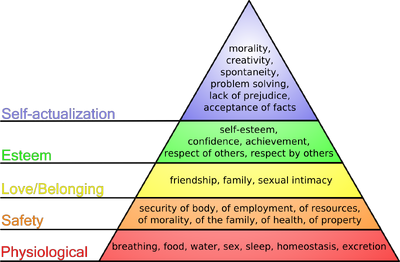
The PAP had been very successful in providing for the physiological needs of the citizens. They had some success with Safety. But as the nation progress, our needs grew. And now they struggle with providing for the Belonging, Esteem and Self-actualization levels of need. Despite surveys showing that bread and butter (Safety) issues are the main concern, a growing number of citizens are starting to be more concern about the meaning of nationhood (Belonging). It is at these levels that the rallies are revolved around.
There are many issues in those categories indeed. I do not feel the need to repeat them. They are readily available. I should just highlight one that concerns me the most. I am most bothered by the astronomical minister pay. It is not that the number is high that bothers me. It is that the bonuses are pegged to GDP growth. This resulted in an “economic-growth-at-all-cost” mentality. Economy growth is good. It is excellence in providing for the Physiological and Safety levels of Maslow's hierarchy of needs. But it fares badly at higher levels. This is the system created by the founding fathers of the nation because this is the system that worked and addresses these early levels of needs. But a paradigm shift is needed now. This system has permeated throughout our society and its negative effects are becoming evident. Personally, as a school teacher, I see students getting overly stressed over the “academic-success-at-all-cost” mentality that echoes the system that currently governs us. The system rewards those who churned out results and wins awards of various kinds rather than those who worked at developing a love for learning. This is the reflection of a government that gives more emphasis to businesses and individuals who can contribute to the economy instead of those who are trying to make this nation a home and a pleasant place to grow old in.
Many politicians claimed track records in this election. Honestly, I am annoyed by that. Track records mean nothing under the framework by which I make my decision. In fact, the whole purpose of having an election every five years is to “erase” these track records and have everyone start again on equal footing. So under this framework, what needs to be done?
The PAP needs to evolve. They cannot sing the same tunes over and over again. They have done well for the first two levels of Maslow's hierarchy of needs. But they cannot ignore the higher levels anymore. They are unfamiliar in those levels. In that sense, they are rookie, just like the opposition. There is the counter argument that there is no guarantee that opposition will be able to produce results. That is also true. There is no way of knowing the future. Some of them will succeed, some will not. So they are rookies, just like the PAP.
So what is the voter to do?
I simply vote for the one that tries the harder.
04 May 2011
28 April 2011
Being Neutral
Nomination was yesterday. Amidst all the excitement, we are reminded that as civil servants, we ought to maintain a neutral stand in our professional capacity. So here is my declaration:
- I do not care which party you belong to; except that you belong to Singapore.
- I do not care what you had done in the past or your track record; I am only interested in what you will do and intend to do in the future.
- I do not care what you had achieved on a personal level; I am only interested in what you want to help others achieve and aspire towards.
Note that each time I say "you", I meant you and not your party.
I am not an expert in matters of governance. My experience is limited to maybe a couple of city-building simulation games on my computer. I have little knowledge of economics and estate management. And macro- and meta- planning usually escape me.
But I do know a sincere man/woman when I meet one. Humility and Honesty is all I ask from a politician.
Show me your sincerity, and I will show you my vote.
That is neutrality.
27 April 2011
Graduation
And so I submitted my final assignment for my masters course a two-day ago. Barring any accident, I should be graduating successfully as a Master of Education (Mathematics) degree holder. This journey as a part-time student has not been easy as any who attempted to work full-time and study part-time can relate. But it is done. And I now reflect on why I really embark on this journey.
I knew the reason once. I am a mathematics teacher by trade. Going for this degree seems a natural progression. Not so. I don’t really need it. It was optional, and it might even be detrimental to my career as I have to slow my pace at work to cope with the studies at times. An ironic situation. But deep down, I knew that I was doing these to compensate my poor showing as a student previously.
I am a teacher. And I am supposed to encourage students to be a good student. Was I one?
Not by the conventional standards used here. I went through primary school pretty much mindlessly. I never knew when are the tests and exams. I never bothered. I go to school thinking of home. I did my assignment as told. Never wondered. Never active in any other activities beyond the classroom. I went for my PSLE without any preparations. I treated it as a normal school day. Never studied the way children are doing it today. I did okay. I failed to go into the “Special Stream” by a whisker. I wept in anger.
But I did not change. My secondary school life is pretty much the same. I remembered being engrossed with the world created by Louis Cha and his sword-fighting heroes when my friends are mugging for their ‘O’ Level. I have my storybooks next to my 10-year series. And my attention is often on the one that did not help with my grades. I did not get the results I desired. But did enough to go to a Junior College.
It was at JC that I started to rebel. I did not complete my assignments like a dutiful nerd that I was. I had my share of cutting classes. I spent my time feeling the anguish self-torment common to many teens. But I did enough to go to a local university.
Maybe I was fortunate. But university was interesting. I was supposed to be reading engineering. It bores me. Instead, I was swept up with the desire to seek a meaning in life. September 11, 2001 just happened. The world seemed to be disintegrating. I was wondering about human nature. I studied the Sutras, the Bible and the Koran. I engaged in countless dialogues. I graduated in engineering with little interest in it, but instead fired up to do something that impact the society more directly. I chose the teaching profession.
But then I realized that I never actually apply myself to study something purely from an academic perspective. And that seems to be driving force that prompted me to take up part-time study. Not for upgrading of skills. Not for career advancement. Purely for academic reason. Really. And I did.
And I think I can close that chapter of my life. Happy with myself as a student. I graduated myself.
12 March 2011
The Great Path of Mentor and Disciple
In Nichiren Buddhism, we speak often of the importance of the mentor-disciple spirit. What does it entails? Why does the Lotus Sutra expound the mentor-disciple relationship?
The mentor-disciple spirit serves the purpose of enabling disciples to realize their mission that they were born with. This mission is explained in the Lotus Sutra as to be born to strive together with our mentor to lead all people to happiness. It is through establishing the bond of mentor and disciple that we are awakened to the purpose of life. Put simply, the purpose of Buddhism is “to realize happiness for oneself and others” via the process of strengthening the mentor-disciple spirit.
However, the egoistic nature that exists within our lives is particularly strong and overbearing. We can all attest to the fact that humans tend towards selfishness. This selfishness clouds our lives, and the egoism in us is what hinders us from realizing and accepting kosen-rufu as our mission in life. But by establishing the mentor-disciple relationship, we are able to overcome our egoistic nature and be awakened to our true mission in life.
To further understand the concept of mentor-disciple spirit, we need to understand the preceding concepts of “reality and wisdom” and “general transfer and specific transfer”. So what is “reality and wisdom”?
The fact that “anyone can become a Buddha” corresponds to “reality”. However, in order for one to become a Buddha, one needs “wisdom”. And this “wisdom” is derived from “faith”. By chanting daimoku and exerting oneself for the sake of kosen-rufu as a “Buddha”, we can achieve the “fusion of reality and wisdom”.
If one does not make any effort to carry out the practice of propagation and focus only on one’s own well-being, the “fusion of reality and wisdom” will not take place. In other words, such an individual is not a Buddha.
For example, a Buddha can be said to be like a physician or doctor in the context of Buddhism. If a doctor does not work to save the lives of his patients, then he or she would fail to qualify as a true doctor.
In other words, the Gohonzon is “reality” and faith is “wisdom”. With strong faith, our lives become one with the Gohonzon in essence. So by chanting daimoku with absolute conviction in the Gohonzon, we can manifest the Buddha’s wisdom in our lives.
How about “general transfer and specific transfer”?
Firstly, in the Lotus Sutra, Shakyamuni Buddha transfers the teachings of Buddhism to his disciples collectively as a whole. This is termed “general transfer”. However, the teachings expounded by Shakyamuni Buddha would lose its beneficial powers in the Latter Day of the Law. For this reason, for the benefit of the people in the Latter Day of the Law, Shakyamuni Buddha transferred the teaching of “Nam-myoho-regnge-kyo” hidden in the depths of the Lotus Sutra to Bodhisattva Superior Practices. This is termed “specific transfer”.
What that means is the in current times with centuries’ worth of teachings dilution it is very difficult to identify what is true and what is inaccurate. General good senses are classified as general transfer of wisdom. But the correct wisdom to acquire to fuse with our reality lies in the specific transfer of wisdom to Bodhisattva Superior Practices. Hence, what is important is to identify the correct person who is manifesting the virtues of Bodhisattva Superior Practices as our mentor or teacher.
What then are the requirements for a good or correct teacher?
The phrase, “desiring little yet knowing satisfaction”, means to discard one’s personal desires and to devote one’s life for the realization of kosen-rufu. With some investigation, we can realize that Nichiren Daishonin and also the three successive presidents of the Soka Gakkai are individuals who did devote their lives for kosen-rufu.
The term “honesty” means to be always grateful to the Gohonzon. The opposite of this is “arrogance”. The arrogant and conceited usually abandon faith when they are not recognized or praised. Those who live their lives based on a vow for kosen-rufu will never do so. The Daishonin practiced in exact accordance with the teachings of the Lotus Sutra. This is what constitutes “honesty”.
Hence, millions of members of Soka Gakkai regarded Nichiren and the current president of Soka Gakkai International, Dr Daisaku Ikeda, as our mentor because they demonstrated the qualities of “desiring little yet knowing satisfaction” and “honesty”.
In summary…
To become a Buddha, we need a mentor. But it is important to choose the right mentor. So to ensure we chose the correct mentor, we have to apply the concept of “general transfer and specific transfer” to recognize the mentor.
And the correct mentor has to guide us to achieve the “fusion of reality and wisdom” so that we are not merely practitioners of Buddhism in theory, but also in actual application to improve our lives.
Chingay 2011 - Final Curtains

First off, I would like to report the successful completion of Chingay. It is the 30th participation in Chingay for Singapore Soka Association. What exactly is the true significance of participating in Chingay for regular citizens like us?
Chingay is a parade of props for us. Every year, we would attempt to create the most interesting props for the participants to dance with. That said, the dance is not the main concern of the choreographers. It is to bring the props to life.
But the props are only as good as the person controlling it. We often tell the participants that the most important thing is to thoroughly enjoy the atmosphere. And smiling has to come from the heart in order to truly bring joy to the performance. So in conclusion, Chingay is really an opportunity to demonstrate the joy we really do achieve in our daily lives. This is the key. It is about changing lives.
17 January 2011
The Right to Human Rights
This morning CARE Talk, the topic of human rights was shared with the students. My eyes moisten. As soon as the presentation was over, I gave a quick instruction to my form class’s chairperson and quickly seek solitude.
I wept.
A story goes that a soldier marched into a country his army had just liberated. He was full of joy that the fighting had ended. Along the street, he met a young child. Eager to make another human being happier, he reached into his pocket and offer the child some sweets.
“I don’t want any sweets,” cried the child. “I only want my brother back from the war. And to go home safely from work (no luxury of school for this child) each day without fear of stepping on a landmine.”
And it dawned on the soldier that he is not prepared to give the child anything.
I wept.
An educator during World War II opposed the military government of Japan at that time. For this protest, he was unjustly imprisoned. When he was released, he vowed to fight this injustice. Not the injustice to his person, but injustice of the war that devastated his country and his country’s neighbors. He vowed to kill the hate in people’s hearts and to rid the world of miserly. His last cries for his students, was the Abolishment of Nuclear Weapons.
It was not the weapon that he actually hated. But what the weapon represented. Traditional weapons were used to fight the enemy who were trying to kill you. Nuclear weapons, for the first time in history, was a weapon designed to kill innocent civilians and to strike terror into the hearts of the population. They represent the violation of the basic Human Right to live.
I wept.
One of this educator’s students wrote to the effect that when a mother gives birth to a child, she is not thinking that this child is an American or an African. She doesn’t care that he is a Christian, Muslim, Hindu or Buddhist. It doesn’t not even matter that child is black or white or have any specific racial features. All she will want is for the child to grow up happy and healthy.
That is the Human Right to be treated simply as a human and respected as a human regardless of background. But many children today are still suffering from poverty, hunger and neglect.
I wept.
I once heard the following in jest, “Fighting for Peace is like Screwing for Virginity”. How myopic! “Peace is not the absence of War!”
Once, when I was younger and a lot more idealistic, I vowed to bring this message of human dignity to the masses. I always believe that my education was for the sake of expanding my sphere of influences so that I can be the part of positive changes for the future. This is one of the reasons I chose to become a school teacher.
But the apathy of youths hurts. There are no values to be inculcated until apathy is utterly demolished. When many of the youths are no longer interested in what the teachers say unless it is remotely related to their examinations and their own personal futures, it dulls the passion.
Have I fallen?
I wept.
The idea of Human Rights is a human construct. It is an idealistic construct. Many skeptics would dismiss it without a second thought. But do ideals not have its purpose and value? Without ideals, can there is hope for the betterment of society? Is that not what being human is truly about?
I am privileged in Singapore. My community is privileged. We do not suffer from the fundamental needs of humanity. But do we not have the responsible to drown the skeptics and bring hope to the sufferers even if their voices are far and their cries are soft? Isn’t that what education really ought to be?
I wept that the right to human rights is not cherished nearly enough.
It is a human right to care, and to dream.
01 January 2011
New Year's Eve

Spent the morning at work in a meeting followed by some spring cleaning. I moved to a new working cubicle. All neat and ready for once. Cheers.
Met up with the Soka trainers of Chingay 2011 to reccee the F1 pit where the event will take place. It rained.
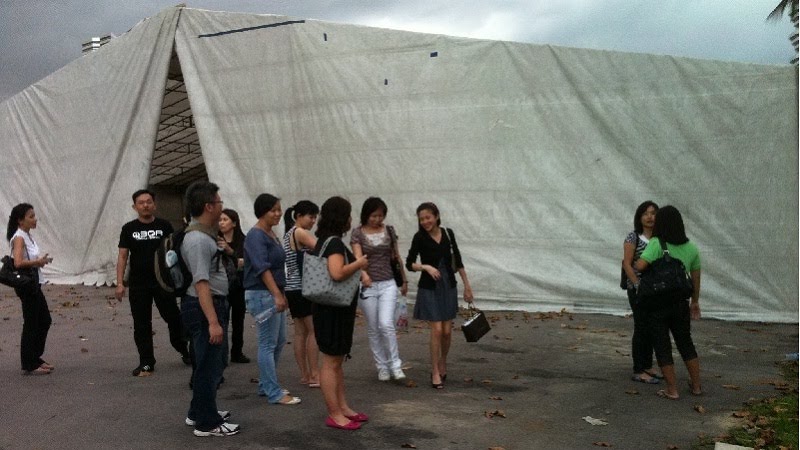
 We checked out the tents where we keep our props and float. And the holding area mainly. Got to ensure safety of the participants in the area.
 Dark Clouds. But nothing cheerful hearts cannot overcome.
Brought the GF to Parkway for a foot massage after. Bought a new pair of trainers.
Happy NEW YEAR.
30 December 2010
Gajukai
Performed my final gajukai duty for the year 2010 in quick succession.
I was on duty for the Singapore Soka Association's commemorative meeting for the 80th Anniversary of SGI. Was assigned to man the admin area before the show begins. Once the show started, served as General Director's escort.
At TSC now for the second duty. Signing off.
Will be checking out the F1 pit tomorrow as preparation for Chingay.
I was on duty for the Singapore Soka Association's commemorative meeting for the 80th Anniversary of SGI. Was assigned to man the admin area before the show begins. Once the show started, served as General Director's escort.
At TSC now for the second duty. Signing off.
Will be checking out the F1 pit tomorrow as preparation for Chingay.
09 October 2010
Eat, Pray, Love

And so I went to the movie with the girlfriend last night and we caught the show Eat, Pray, Love. Here’s a quick personal review of the film:
Enter this 32-year-old Elizabeth Gilbert played by Julia Roberts who was educated and had a home, a husband, and a successful career as a writer. But she gets all emotional and unsatisfied about life and threw all that away for a sabbatical year to Italy, India and Bali.
The girlfriend commented after the show that she could easily had gone for the soul-searching trip without destroying her previous life. I totally agree. It is not her circumstances that she had to change. In fact, her circumstance was GOOD by many standards. It was her perspective on life that needs to be altered. The protagonist came across as narcissistic and egocentric. Selfish in her dealings and unlikeable. But of course she made those mistakes due to ignorance about what a good life is and she redeemed herself through her philosophical musings and growth after that.
In Rome, she pondered about the impermanence of life at the tomb of Augustus Caesar. Life, in both the macro and micro sense, is always evolving and adapting. A good start. This is also the starting point of Shakyamuni when he first expounded Buddhism. The recognition of the impermanence allows us to set the priorities in our life straight. Wealth and status are useful in providing a quality standard in living, but they are not the deciding factor in our pursuit of happiness. We can pursuit them but never should they become the centre of our devotion.
In India, she finally learn to still her mind and concluded that “God exist within you as you”. Interesting take. Buddhism has often been accused as not being a religion because of Buddhists does not believe in an exterior Creator-God. In fact, we can say that Buddhism is fundamentally ascetic. Misinformed people will often think that Buddha is the Buddhists’ equivalent of God. That is incorrect. Buddha is simply a term for an enlightened human being. The key message of Buddhism is that the ability to become a Buddha exists within us. When we manifest courage, wisdom and compassion, Buddhahood is manifested as us as we are. What she did was really to redefine her previous understand of Abrahamic God as Buddha.
In Bali, she learnt to “let go” of her control and live life as it is. This, from the Buddhist perspective is progression to the concept of “Buddhahood is Daily Life” as taught by the Soka Gakkai. Buddhism is not a passive way of life mediating in some calm corner of existence. Buddhism is to take active steps to better our society based on our enhanced sensitivity to life.
Overall, her journey mildly mirrors Shakyamuni’s own from hedonism (eat), to ascetic (pray), to the Middle Way (love).
So I concluded that the philosophical musings are interesting, the plot is somewhere simplistic and lame, but the acting of Julia Roberts is excellence in portraying the mixed emotions. Richard Jenkins was outstanding and Hadi Subiyanto is adorable.
04 October 2010
Ready for Chingay Audition
The weekend past signal the start of Chingay 2011. The trainers gathered for the first time to learn the dance steps which will be used for the auditions. The recruitment will on the the 10th and 17th of October at Telok Blangah Soka Centre. 10am.
Side note: Invigilating language paper 1s always gives me the urge to write fiction again. But alas, not a priority.
Side note: Invigilating language paper 1s always gives me the urge to write fiction again. But alas, not a priority.
28 September 2010
The Power of Sound
Last night I tweeted the following: The sense of hearing is the first to develop when we are forming in our mothers' womb. It is also the last to "shut down" at our dying.
There are many layers to this statement.
The first layer is the physical aspect of this. Medical sciences are revealing that foetuses react more sensitively to sound than light. Death is also a gradual process (in ordinary circumstances). The various organs of our physical bodies do not all die at the same time. Our ears never shut down until all other organs ceased.
This transits to our emotional attachments to our sense of hearing. We can shut our eyes. We can hold our breaths. And we can close our mouths. But we cannot turn off our hearing naturally. Yet the art of listening is one of the hardest skills to develop. Listening is such a powerful emotional tool that to have someone who listens from their hearts is thousands times more healing than to have a thousand words spoken to us in times of emotional stress.
The act of hearing and listening also has a deep significance spiritually. In the many cultures, emphasis had been placed on light and sight. The genesis began by declaring that God created that light first by saying “Let there be light...”
But my Buddhist studies led me to believe that this is inaccurate. I believe that sound comes first. (I know light travel faster and hence more obvious. But we are not discussing speed here.) Just like sound is first observed by the foetus, sound is the original building block of the cosmic energy. Sound is the energy that is most associated with vibrations which is the driving force for all reactions at the atomic and sub-atomic levels.
Anyone with a basic knowledge of Buddhism would know that Buddhist practices are usually revolved around meditation and chanting.
Meditation is a useful tool to calm our bodies and minds. But the question is, why do we need to calm? It is to heighten our sense of hearing. To hear our own minds. Seriously.
Chanting occurs when there is a rhythm we identified to be important and wanted to embrace. The purpose of chanting is for us to hear this rhythm, and to reinforce it into our lives. In Nichiren Buddhism, we learnt that the most important rhythm of life is manifested in Nam-myoho-renge-kyo. And that is the chanting I do. I do it, to hear it, so that I may embrace it in death.
There are many layers to this statement.
The first layer is the physical aspect of this. Medical sciences are revealing that foetuses react more sensitively to sound than light. Death is also a gradual process (in ordinary circumstances). The various organs of our physical bodies do not all die at the same time. Our ears never shut down until all other organs ceased.
This transits to our emotional attachments to our sense of hearing. We can shut our eyes. We can hold our breaths. And we can close our mouths. But we cannot turn off our hearing naturally. Yet the art of listening is one of the hardest skills to develop. Listening is such a powerful emotional tool that to have someone who listens from their hearts is thousands times more healing than to have a thousand words spoken to us in times of emotional stress.
The act of hearing and listening also has a deep significance spiritually. In the many cultures, emphasis had been placed on light and sight. The genesis began by declaring that God created that light first by saying “Let there be light...”
But my Buddhist studies led me to believe that this is inaccurate. I believe that sound comes first. (I know light travel faster and hence more obvious. But we are not discussing speed here.) Just like sound is first observed by the foetus, sound is the original building block of the cosmic energy. Sound is the energy that is most associated with vibrations which is the driving force for all reactions at the atomic and sub-atomic levels.
Anyone with a basic knowledge of Buddhism would know that Buddhist practices are usually revolved around meditation and chanting.
Meditation is a useful tool to calm our bodies and minds. But the question is, why do we need to calm? It is to heighten our sense of hearing. To hear our own minds. Seriously.
Chanting occurs when there is a rhythm we identified to be important and wanted to embrace. The purpose of chanting is for us to hear this rhythm, and to reinforce it into our lives. In Nichiren Buddhism, we learnt that the most important rhythm of life is manifested in Nam-myoho-renge-kyo. And that is the chanting I do. I do it, to hear it, so that I may embrace it in death.
27 September 2010
Back
Decided to revive this blog. Mainly in anticipation of my involvement in Chingay 2011 which I wished to be able to document meaningfully. More tomorrow.
22 July 2010

26 June 2010

25 June 2010
Song of Youth
Though clouds dot the sky
and the wind blows
the sun rises again today
the morning sun of youth
holding within itself limitless power
as it spreads its light abroad
advances on a correct course
~ "Song of Youth"
What is my correct course?
At age 30, I feel I had so much yet to accomplish. Will I be a worthy disciple to my mentor?
Must work harder!
05 June 2010
Be Patient and Persevere
"Don't despair when things don't go as you had hoped. Don't become depressed and sorry for yourself. Be patient and persevere, putting down solid roots and creating the cause for more fortunate circumstances to present themselves in the future. Faith is about putting down roots of happiness in the soil of our present reality. Eventually sprouts will appear and flowers will begin to bloom in beautiful profusion signalling the arrival of a spring of victory and success."
- Daisaku Ikeda
20 May 2010
Revisiting The Three Poisons
In most industries, when a man begins on a new job, he will be placed on probation until confirmation. While he is on probation, he does enjoy all the benefits of the job. But once the probation period is over, there will be expectation if he were to continue to flourish in the job. The same idea can also be applied to the Buddhist practice. When we start to practice Buddhist and chant Nam-Myoho-Renge-Kyo, benefits will start pouring in and our immediate problems will be solved. But after practicing for some time, if we fail to develop a sense of gratitude and apply ourselves in the noble endeavors of Kosen Rufu, we will eventually be frustrated. We have to repay this debt of gratitude by encourage our fellow members, care for our families and be a positive source of energy in our social circles. The practice of Buddhism is ultimately the practice of compassion. The power of Nam-Myoho-Renge-Kyo is manifested in direct correlations to our efforts in this aspect.
Some time back, I gave a lift to a colleague when a conversation on the Three Poisons was initiated. I explained that the Three Poisons in Buddhism refers to the poisons of Greed, Anger and Foolishness which is the cause of all man-made disasters in human terms. Having come from a Methodist background, she commented that the concept of Foolishness is the most difficult to understand compared to Greed and Anger. The concept of Foolishness came to me quite naturally due to my upbringing. I understand it well enough as the delusional state of life where one fails to differentiate right from wrong. But receiving such feedback, I did come to realize that it can be difficult from those who are not familiar with oriental philosophies.
Given time to meditate and ponder deeper into the issue, I finally develop an understanding which I would like to share here. The key lies in the compassion. The Three Poisons are all human characteristics that run counter to compassion. There are the drivers of selfishness and egoism. It is the selfish materialistic impulses that generate Greed. And Anger is generated when selfish desires are not fulfilled. And finally, Foolishness. Foolishness is the result of selfish arrogance. It is when we lose our humble seeking spirit and turn away from wisdom thinking we are above it.
This is also why the practice of Kosen Rufu, or the practice of compassion is important. It is this practice that changes and transforms these inherent Three Poisons in our lives into medicines for societal improvements.
Since Vesak Day is coming, I would also like to briefly share about the efforts of the historical Buddha Shakyamuni. Shakyamuni lived in a time where the extremes of hedonistic and ascetic behaviors are rampant. Note that both these extremes are inherently egoistic pursuits. Buddhism was born to correct that situation. Hinayana Buddhism was first developed to teach everyone that we are all inherently equal because we share the same Buddha nature. But with time, even Hinayana fell into the traps of the Three Poisons and become a ritualistic religion lacking in compassion for the masses. Mahayana Buddhism arose then to encourage the compassionate acts of encouraging the common lay people. But again, with the passing of time, Mahayana fell to egoism of another form. With the deitifying of Shakyamuni and his disciples, the acceptance of our Buddha nature is diluted and eventually, the concept of the equality of all life is lost and class distinction is formed.
It is the Nichiren who first recognize these and restore Buddhism to its original intent to teach both the existence of our Buddha nature and the importance of compassionate acts. And it is Soka Gakkai today who are putting Nichiren’s teaching into practice and going all out for Kosen Rufu. It is my greatest pride to be part of this movement.
Further Readings on The Three Poisons
Some time back, I gave a lift to a colleague when a conversation on the Three Poisons was initiated. I explained that the Three Poisons in Buddhism refers to the poisons of Greed, Anger and Foolishness which is the cause of all man-made disasters in human terms. Having come from a Methodist background, she commented that the concept of Foolishness is the most difficult to understand compared to Greed and Anger. The concept of Foolishness came to me quite naturally due to my upbringing. I understand it well enough as the delusional state of life where one fails to differentiate right from wrong. But receiving such feedback, I did come to realize that it can be difficult from those who are not familiar with oriental philosophies.
Given time to meditate and ponder deeper into the issue, I finally develop an understanding which I would like to share here. The key lies in the compassion. The Three Poisons are all human characteristics that run counter to compassion. There are the drivers of selfishness and egoism. It is the selfish materialistic impulses that generate Greed. And Anger is generated when selfish desires are not fulfilled. And finally, Foolishness. Foolishness is the result of selfish arrogance. It is when we lose our humble seeking spirit and turn away from wisdom thinking we are above it.
This is also why the practice of Kosen Rufu, or the practice of compassion is important. It is this practice that changes and transforms these inherent Three Poisons in our lives into medicines for societal improvements.
Since Vesak Day is coming, I would also like to briefly share about the efforts of the historical Buddha Shakyamuni. Shakyamuni lived in a time where the extremes of hedonistic and ascetic behaviors are rampant. Note that both these extremes are inherently egoistic pursuits. Buddhism was born to correct that situation. Hinayana Buddhism was first developed to teach everyone that we are all inherently equal because we share the same Buddha nature. But with time, even Hinayana fell into the traps of the Three Poisons and become a ritualistic religion lacking in compassion for the masses. Mahayana Buddhism arose then to encourage the compassionate acts of encouraging the common lay people. But again, with the passing of time, Mahayana fell to egoism of another form. With the deitifying of Shakyamuni and his disciples, the acceptance of our Buddha nature is diluted and eventually, the concept of the equality of all life is lost and class distinction is formed.
It is the Nichiren who first recognize these and restore Buddhism to its original intent to teach both the existence of our Buddha nature and the importance of compassionate acts. And it is Soka Gakkai today who are putting Nichiren’s teaching into practice and going all out for Kosen Rufu. It is my greatest pride to be part of this movement.
Further Readings on The Three Poisons
16 May 2010
15 May 2010
Seeing the Good in Others
"How do you see others? In most cases, your vision of others is a mirror that reflects your own mind just ad it is. If, for example, you are a greedy, covetous sort, you will not be able to perceive others' sincerity. Even honesty will appear dwarfed because of your enormous greed. It's not that others lack integrity. It's that you are too greedy."
- Daisaku Ikeda
26 April 2010
The Weightage of Chinese Language
The weightage of Chinese Language for the PSLE is in debate recently. Personally, I would call those who call for a reduction of the weightage quitters. Although the argument that English is the medium used in all administrations in Singapore, the value of the Chinese cannot be ignored.
I used to be rather good in my Chinese. I remember scoring A1s when I was a student. But the truth is that with lack of usage over the years, my standard in the language has deteriorated much. However, I pride myself as having once exposed myself extensively in the language. For the value in a language is not in the usage, but the appreciation in its culture. I cannot write or read as well in Chinese as when I was a student, but my appreciation for it grows with time. The tenacity to work on doing well for it is also a lesson well-learned.
If you worry about the “Brain Drain” due to an inability to do well in the Chinese, then maybe we should be aware that these are also “weaker brains” that can’t cope. Then they should just go. I will not miss them.
I used to be rather good in my Chinese. I remember scoring A1s when I was a student. But the truth is that with lack of usage over the years, my standard in the language has deteriorated much. However, I pride myself as having once exposed myself extensively in the language. For the value in a language is not in the usage, but the appreciation in its culture. I cannot write or read as well in Chinese as when I was a student, but my appreciation for it grows with time. The tenacity to work on doing well for it is also a lesson well-learned.
If you worry about the “Brain Drain” due to an inability to do well in the Chinese, then maybe we should be aware that these are also “weaker brains” that can’t cope. Then they should just go. I will not miss them.
16 April 2010
JC or POLY
For the past few days, the local newspapers carried the story of whether the local universities should allow a larger percentage of POLY graduates to enter the universities (at the expense of the JC students). Here is a brief of my take.
Firstly, the JCs are designed to prepare students for universities.
I appreciate the embracing gestures of the universities to admit POLY graduates. I believe this allows "slow-starters" an opportunity for higher education. And I admire those who, having had to go to the ITE, work hard, and progress to POLY and then the universities. These are the fighters.
But I have no sympathy for those who qualified for JC, but chose to go POLY on their own free will and then whine about not being given a shot at the university.
Go to the JCs if the university had always been your target. If you can't make it to the JC, but still wished to study at the highest level, then you ought to prove that you deserve to be with the best.
And remember that an university offered to you means an opportunity lost to another. Universities graduates owes the society a profound debt of gratitude. It is a privilege, NOT a right.
Firstly, the JCs are designed to prepare students for universities.
I appreciate the embracing gestures of the universities to admit POLY graduates. I believe this allows "slow-starters" an opportunity for higher education. And I admire those who, having had to go to the ITE, work hard, and progress to POLY and then the universities. These are the fighters.
But I have no sympathy for those who qualified for JC, but chose to go POLY on their own free will and then whine about not being given a shot at the university.
Go to the JCs if the university had always been your target. If you can't make it to the JC, but still wished to study at the highest level, then you ought to prove that you deserve to be with the best.
And remember that an university offered to you means an opportunity lost to another. Universities graduates owes the society a profound debt of gratitude. It is a privilege, NOT a right.
14 April 2010
31 March 2010
Lesson from the Titanic
Molly Brown was on board the Titanic as a first class passenger. When the passenger liner RMS Titanic tragically sinking in on April 14, 1912 after striking an iceberg. There was a chaos and panic all around.
She volunteered to help others board the lifeboats for most of the night until finally convinced to leave the ship in Lifeboat No. 6. Most of the passengers were desperate for the lifeboat to get to safety. But she insisted that the lifeboat to go back to look for survivors after learning that it was not yet carrying full capacity.
Initially she was met with strong opposition from Quartermaster Hichens, the crewman in charge of Lifeboat 6, who believed that nobody would be saved by going back as the boat would be pulled down by the ship's suction or by the force of everyone scrambling to get aboard.
But she shouted courageously to a panic-stricken fellow passengers: "There's no danger. It simply can't go down, because I'm on it and I'm unsinkable." Her bantering words, which rang out with the determination never to be defeated and never to give in to despair are said to have given courage to her fellow passengers.
Those who stand up at a crucial moment demonstrate genuine greatness.
She volunteered to help others board the lifeboats for most of the night until finally convinced to leave the ship in Lifeboat No. 6. Most of the passengers were desperate for the lifeboat to get to safety. But she insisted that the lifeboat to go back to look for survivors after learning that it was not yet carrying full capacity.
Initially she was met with strong opposition from Quartermaster Hichens, the crewman in charge of Lifeboat 6, who believed that nobody would be saved by going back as the boat would be pulled down by the ship's suction or by the force of everyone scrambling to get aboard.
But she shouted courageously to a panic-stricken fellow passengers: "There's no danger. It simply can't go down, because I'm on it and I'm unsinkable." Her bantering words, which rang out with the determination never to be defeated and never to give in to despair are said to have given courage to her fellow passengers.
Those who stand up at a crucial moment demonstrate genuine greatness.
22 March 2010

02 February 2010
The Return of Zalankai
And so the month of January ends. I was thinking about how time seems to pass faster as we grow older; the DJ on the radio said the same thing. As we become busier and laden with increasing responsibility, time is indeed a luxury. I would like to think that I began the new year managing my time reasonably well and had fallen into a firm rhythm.
And highlight of the month of January for me had to be the return of the discussion meetings of the Singapore Soka Association. After half the year of suspension of the meetings due to the precautions measures taken against the H1N1 pandemic, the discussion meetings resumed with vigor across the country. In my chapter, we managed an attendance of 155 from 4 districts.
The discussion meeting is an informal gathering of people from all walks of life coming together to share their struggles and challenges, as well as to encourage one another to achieve victories over our various problems through the application of Buddhism in our daily life. The positive social force generated by this seemingly insignificant activity cannot be underestimated. In Singapore currently, over 400 districts were conducted simultaneous at various members’ homes with about 30-50 members and friends of the association attending at each session.
I learnt recently that the current top ‘O’ Levels student of the school I’m teaching at, Atreya, is also a member of Soka Gakkai. Hence, I invited him to speak at one of the discussion meeting I was facilitating. He shared frankly that it was the application of Buddhist principles that contributed most to his victory in his studies. Another student, Lup Seng, who made vast improvement from his preliminary examination to the ‘O’ Level was also in attendance. But he claimed to be too shy to share.
And highlight of the month of January for me had to be the return of the discussion meetings of the Singapore Soka Association. After half the year of suspension of the meetings due to the precautions measures taken against the H1N1 pandemic, the discussion meetings resumed with vigor across the country. In my chapter, we managed an attendance of 155 from 4 districts.
The discussion meeting is an informal gathering of people from all walks of life coming together to share their struggles and challenges, as well as to encourage one another to achieve victories over our various problems through the application of Buddhism in our daily life. The positive social force generated by this seemingly insignificant activity cannot be underestimated. In Singapore currently, over 400 districts were conducted simultaneous at various members’ homes with about 30-50 members and friends of the association attending at each session.
I learnt recently that the current top ‘O’ Levels student of the school I’m teaching at, Atreya, is also a member of Soka Gakkai. Hence, I invited him to speak at one of the discussion meeting I was facilitating. He shared frankly that it was the application of Buddhist principles that contributed most to his victory in his studies. Another student, Lup Seng, who made vast improvement from his preliminary examination to the ‘O’ Level was also in attendance. But he claimed to be too shy to share.
 Atreya Sharing...
 SRS District 2
 SRS District 3
 SRS District 4
12 January 2010
14 December 2009
Crash!
This morning, as I was ferrying the girlfriend to work as per the routine every school vacation, a black Mazda 6 forced his way to overtake me along the merging slip road leading to TPE. Once we were on the expressway, a lorry immediately cut in front of me forcing me to slow down significantly. The next thing I know, the lorry swirled and I jammed my breaks. I managed to stop my car just before hitting the lorry.
The next few seconds feels almost like a slow motion feature when the black Mazda 6, which was now just ahead of the lorry, swung across the expressway in a fashion usually seen only in a Hollywood movie and crashed into the side railings.
In that instance, I felt the protective powers of the shoten zenjin. Had I not backed away at the slip road as he was trying to overtake me, the positions of our vehicles would be reversed and I would be the “Hollywood stuntman”. On my return trip after sending the girlfriend to work, I noted that an ambulance was at location. I guessed he sustained quite a serious injury. I wish him well and speedy recovery.
And I believe the hour plus daimoku I did during gajukai duty works.
Nam-myoho-renge-kyo.
The next few seconds feels almost like a slow motion feature when the black Mazda 6, which was now just ahead of the lorry, swung across the expressway in a fashion usually seen only in a Hollywood movie and crashed into the side railings.
In that instance, I felt the protective powers of the shoten zenjin. Had I not backed away at the slip road as he was trying to overtake me, the positions of our vehicles would be reversed and I would be the “Hollywood stuntman”. On my return trip after sending the girlfriend to work, I noted that an ambulance was at location. I guessed he sustained quite a serious injury. I wish him well and speedy recovery.
And I believe the hour plus daimoku I did during gajukai duty works.
Nam-myoho-renge-kyo.
25 November 2009
Nine Years On
And so. Today is the 9th year anniversary since I met my mentor Daisaku Ikeda in person.
Have I done enough to help him fulfill his great goal of Kosen Rufu?
[ Kosen Rufu = A vision of social peace brought about by the widespread acceptance of the Buddhist core value of unfailing respect for the dignity of human life. ]
Need to reflect on myself seriously and renew my vow before the Gohonzon.
Nam-myoho-renge-kyo.
Nam-myoho-renge-kyo.
Nam-myoho-renge-kyo.
Have I done enough to help him fulfill his great goal of Kosen Rufu?
[ Kosen Rufu = A vision of social peace brought about by the widespread acceptance of the Buddhist core value of unfailing respect for the dignity of human life. ]
Need to reflect on myself seriously and renew my vow before the Gohonzon.
Nam-myoho-renge-kyo.
Nam-myoho-renge-kyo.
Nam-myoho-renge-kyo.
17 November 2009
As the school bell softly rings
As the school bell softly rings
Time to say our farewells
We are no longer the same
After the hours spent together
It is your struggle and your toils
That brings a new clarity
To the window of wisdom
That shines forever within
As we blundered our way
We learn to find our paths
Hearts filled with treasure
We set sail with confidence
Let every youthful hearts venture forth
Into the great ocean of life
Riding every waves
Braving every storms
A thousand thoughts this day
With a single thank we sing
Cherishing gratitude in our hearts
As the school bell softly rings
~ Dedicated to the MF graduating class of 2009
Subscribe to:
Posts (Atom)